
RugWard Pay
Webhooks and signature verification
Get a signed HTTPS notification on every invoice status change, verify it in curl, Node.js, Python or PHP, and handle retries and duplicates safely.
On this page
How webhooks work#
When an invoice changes status, RugWard sends a POST with a JSON body to your endpoint. Each request is signed with your signing secret, so you can prove it came from RugWard and was not changed.
Set up#
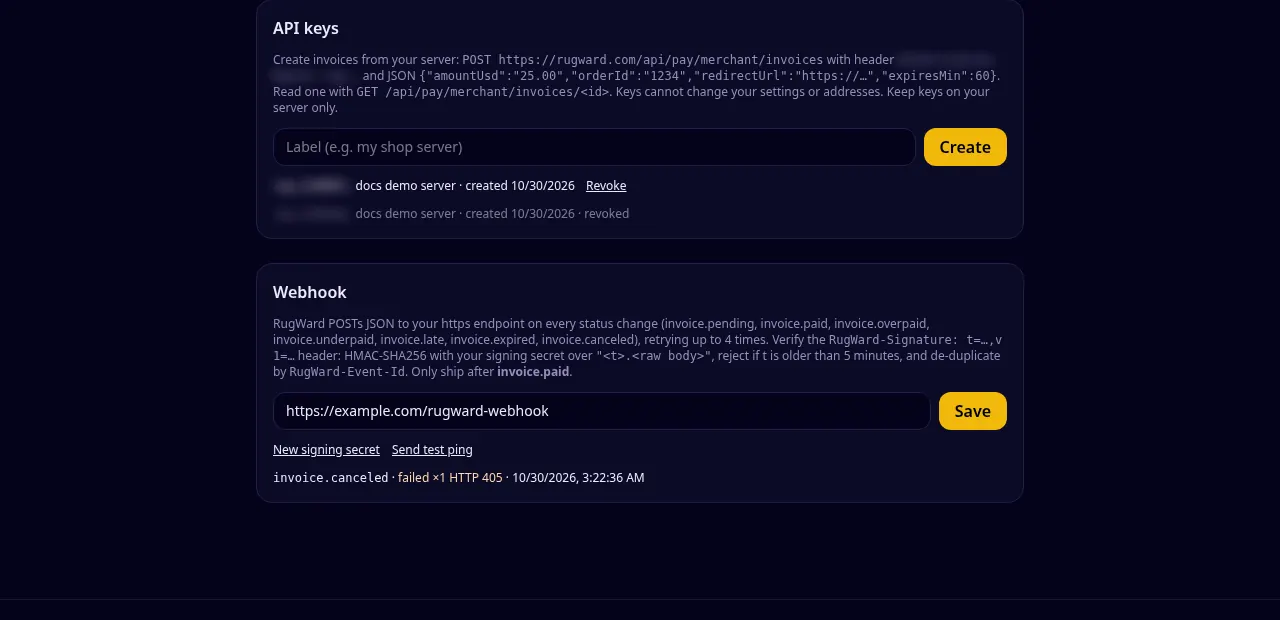
- In the dashboard, enter your endpoint in Webhook and click Save.
- The signing secret (
whsec_followed by 40 characters) is shown once. Store it on your server, next to the API key. - Click Send test ping. The dashboard shows the HTTP status your endpoint returned.
- The delivery log under the box shows each event, its result and the number of attempts.
Endpoint rules:
https://only, on the standard port (no:8443), max 500 characters;- a public host name: IP addresses,
localhostand private networks are refused; - answer within 10 seconds with any 2xx status. Redirects are not followed: a 3xx answer counts as a failure.
New signing secret replaces the secret immediately; deploy the new one right away (signatures made with the old secret stop at once). Saving an empty URL turns webhooks off.
Events#
| Event | Sent when |
|---|---|
invoice.pending | a payment was seen, waiting for confirmations or for the rest of the amount |
invoice.paid | fully paid and confirmed: ship |
invoice.overpaid | paid with more than 1% extra: ship |
invoice.underpaid | the rate lock ended with too little confirmed |
invoice.late | a payment arrived after expiry |
invoice.expired | expired without payment |
invoice.canceled | you canceled it |
ping | the dashboard's Send test ping button |
Every event fires at most once per invoice. Test invoices never send webhooks.
The request#
POST /rugward-webhook HTTP/1.1
Host: shop.example
Content-Type: application/json
User-Agent: RugWard-Pay-Webhook/1.0
RugWard-Event-Id: Zx3kQ8pL2mN7vR1tY5wB9c:paid
RugWard-Event: invoice.paid
RugWard-Signature: t=1793324105,v1=5f0c3d0e8b1a…(64 hex characters){
"id": "Zx3kQ8pL2mN7vR1tY5wB9c:paid",
"type": "invoice.paid",
"created": 1793324100,
"data": {
"invoice": {
"id": "Zx3kQ8pL2mN7vR1tY5wB9c",
"status": "paid",
"amountUsd": "25.00",
"orderId": "1234",
"description": "1 x T-shirt, size M",
"redirectUrl": "https://shop.example/thanks?order=1234",
"createdAt": 1793323282069,
"expiresAt": 1793326882069,
"paidAt": 1793324100512,
"assets": ["BTC", "ETH-8453", "USDC-8453"],
"test": false,
"quotes": [{ "id": 4711, "asset": "USDC-8453", "amount": "25.000629", "rateUsd": "1", "address": "0x…", "expiresAt": 1793325082069 }],
"payments": [{ "txid": "0x…", "asset": "USDC-8453", "amount": "24.875626", "confirmations": 30, "required": 30, "confirmed": true, "seenAt": 1793324012000, "explorer": "https://basescan.org/tx/0x…" }]
}
}
}{ "id": "ping:1793324000000", "type": "ping", "created": 1793324000, "data": {} }idis<invoice id>:<status>and is also in theRugWard-Event-Idheader: use it to ignore duplicates.createdis in Unix seconds;data.invoiceis the same object asGET /api/pay/merchant/invoices/:idreturns.
Verify the signature#
The header looks like RugWard-Signature: t=1793324100,v1=5f2c… (64 hex characters).
- Read the raw request body exactly as received (before any JSON parsing).
- Compute
HMAC-SHA256(secret, t + "." + raw_body)and hex-encode it. - Compare it with
v1in constant time. - Reject the request if
tis more than 5 minutes away from your clock (stops replays). - Only then parse the JSON.
Parsing the JSON first and re-serializing it changes the bytes and breaks the signature. Always sign-check the raw body.
import crypto from "node:crypto";
import express from "express";

const SECRET = process.env.RUGWARD_WEBHOOK_SECRET; // whsec_…
const app = express();

// Use the RAW body: the signature covers the exact bytes RugWard sent.
app.post("/rugward-webhook", express.raw({ type: "application/json" }), (req, res) => {
  const raw = req.body.toString("utf8");
  const m = /^t=(\d+),v1=([0-9a-f]{64})$/.exec(req.get("RugWard-Signature") || "");
  if (!m || Math.abs(Date.now() / 1000 - Number(m[1])) > 300) return res.sendStatus(400);
  const want = crypto.createHmac("sha256", SECRET).update(`${m[1]}.${raw}`).digest("hex");
  if (!crypto.timingSafeEqual(Buffer.from(want), Buffer.from(m[2]))) return res.sendStatus(400);

  const event = JSON.parse(raw);
  // De-duplicate: the same event id can arrive more than once.
  // if (alreadyProcessed(event.id)) return res.sendStatus(200);
  if (event.type === "invoice.paid" || event.type === "invoice.overpaid") {
    const inv = event.data.invoice;
    // markOrderPaid(inv.orderId, inv.id);  // ship only now
  }
  res.sendStatus(200); // any 2xx = delivered
});
app.listen(3000);import hashlib, hmac, json, os, re, time
from flask import Flask, abort, request
SECRET = os.environ["RUGWARD_WEBHOOK_SECRET"].encode() # whsec_…
app = Flask(__name__)
@app.post("/rugward-webhook")
def rugward_webhook():
raw = request.get_data() # raw bytes, exactly as sent
m = re.fullmatch(r"t=(\d+),v1=([0-9a-f]{64})", request.headers.get("RugWard-Signature", ""))
if not m or abs(time.time() - int(m.group(1))) > 300:
abort(400)
want = hmac.new(SECRET, m.group(1).encode() + b"." + raw, hashlib.sha256).hexdigest()
if not hmac.compare_digest(want, m.group(2)):
abort(400)
event = json.loads(raw)
if event["type"] in ("invoice.paid", "invoice.overpaid"):
inv = event["data"]["invoice"]
# mark_order_paid(inv["orderId"], inv["id"]) # de-duplicate on event["id"]
return "", 200<?php
$secret = getenv("RUGWARD_WEBHOOK_SECRET"); // whsec_…
$raw = file_get_contents("php://input");
$sig = $_SERVER["HTTP_RUGWARD_SIGNATURE"] ?? "";
if (!preg_match('/^t=(\d+),v1=([0-9a-f]{64})$/', $sig, $m) || abs(time() - (int)$m[1]) > 300) {
http_response_code(400); exit;
}
$want = hash_hmac("sha256", $m[1] . "." . $raw, $secret);
if (!hash_equals($want, $m[2])) { http_response_code(400); exit; }
$event = json_decode($raw, true);
if (in_array($event["type"], ["invoice.paid", "invoice.overpaid"], true)) {
$inv = $event["data"]["invoice"];
// mark_order_paid($inv["orderId"], $inv["id"]); // de-duplicate on $event["id"]
}
http_response_code(200);To test your endpoint by hand, sign a body yourself:
SECRET='whsec_…'            # your signing secret
BODY='{"id":"ping:1","type":"ping","created":1793324000,"data":{}}'
T=$(date +%s)
SIG=$(printf '%s.%s' "$T" "$BODY" | openssl dgst -sha256 -hmac "$SECRET" -hex | sed 's/^.* //')

curl -X POST https://shop.example/rugward-webhook \
  -H "Content-Type: application/json" \
  -H "RugWard-Event: ping" \
  -H "RugWard-Signature: t=$T,v1=$SIG" \
  --data "$BODY"
Retries and duplicates#
If your endpoint times out or does not answer 2xx, RugWard retries: up to 4 attempts in total, after about 30 seconds, 2 minutes and 8 minutes. After that the event is marked failed in the delivery log. Your handler should therefore:
- answer 2xx quickly and do slow work afterwards;
- be idempotent: store
RugWard-Event-Idand skip events you have already processed; - not depend on order: re-read the invoice with the API when in doubt.
Webhooks are a fast signal, not the only one. If your server was down for a while, list recent invoices with the API and compare statuses.
Troubleshooting#
| Symptom | Likely cause |
|---|---|
| "Webhook URL must be https:// with a public host name" | an IP address, a custom port, http:// or an internal host name |
| ping shows HTTP 301/302/308 | your server redirects (for example http→https, or a missing trailing slash); use the final URL |
| ping shows 405 | the route does not accept POST |
| signature never matches | the body was parsed or re-encoded before hashing, the wrong secret is used (after New signing secret), or the server clock is wrong |
| no events for test invoices | expected: test invoices never send webhooks |
Last updated: October 30, 2026